home about contact recipe index faqs

Wednesday, February 12, 2014

Healthy Habits Challenge February: Eat Less Sugar, Part 2

Welcome back to this month's Healthy Habits Challenge to Eat Less Sugar!! Last week I challenged you to identify where and how much sugar you are getting in your diet. I wonder if anyone was surprised by anything they found. I know as I have tried to do this, I've been at times surprised, even shocked by my sugar intake. But overall, I've tried to not get down on myself, and just realize that by being aware and having a better gauge to work from about how much sugar is in my food I am on my way to making long-term changes about how much sugar I'm eating. So, if you're still with me and committed to those long-term changes about eating less sugar, let's keep going!

You've realized by now that because we love sugar and we are getting it in so many of the foods we eat, most of us are getting much more than is good for us. Not only that, the excessive amounts we are getting all throughout the day change the way we taste and think about our food. When we are getting a lot of sugar, not only can it fuel an addiction to the stuff, it also alters our sensitivity to the taste of sugar and sweetness. Put simply, if everything we eat has some sweetness to it, things that are slightly sweet start to not taste sweet at all, and things that are very sweet taste less sweet. So, if you're like me and constantly looking to fill that sweet tooth, the threshold gets higher and higher and it becomes harder and harder to satiate. Hence, the constant need to have something sweet going into my mouth!

Breaking the Cycle: Changing your Palate, Changing your Habits

The trick to breaking that cycle of needing more and more sweet to fill the craving is to change your palate ... or to bring back your ability to taste (and enjoy) the flavor of foods without tons of sugar. In trying to figure out how to do this for myself, I've discovered that there are essentially two camps of thought about how to reset our sweetness sensitivity: Detox and Moderate.

First, is the detox approach. These approaches favor eliminating, to one degree or another, all things sugary from our diet for a set period of time (anywhere from 3 to 8 weeks, or more) to allow the body and brain to "reset." Depending on the approach, this may include not only refined sugars, but also natural sweeteners (honey, agave, maple syrup, molasses, etc.), artificial sweeteners, fruit, and even many carbs (the idea being that carbs convert to sugar in our body and so fuel the sugar addiction further). One approach I've looked at even suggested getting rid of peanuts and cashews, as well as caffeine, claiming that these also trigger sugar cravings. The idea behind this approach is that it clears the body of sugar, and resets the brain from craving sweetness. After the elimination period, you can then reintroduce moderate amounts of certain types of sugar, creating healthier habits around sugar. Some of the criticisms of this type of approach to eliminating or reducing sugar is that because it calls for drastic changes for most people, it is unsustainable and more likely to either a) fail, or b) not lead to long-term changes to eating habits.

The second approach is what I think of as the "moderation approach." Supporters of this approach suggest that sugar is acceptable in moderation, and if we are getting too much of it we can tone down our cravings by gradually eliminating sugar from our eating. Suggestions on how to do this include putting less and less sugar in coffee or tea, reducing or eliminating sugary beverages, substituting sugary snacks for healthier alternatives, replacing syrups or other sugary toppings with low-sugar options (such as replacing syrup with pureed fruit). By gradually reducing sugar in our diets, supposedly our sensitivity to sugar will increase, and so our desire for it will decrease. On the other hand, critics say that if a person is truly "addicted" to sugar in the same or similar way as someone becomes addicted to other substances, then all of those addictive brain chemicals start screaming "more! More! MORE!" the minute we ingest sugar, and so "moderating" our sugar intake becomes impossible because those sugar monsters are just so darned difficult to ignore.

I'm not going to tell you which approach is the right one - mostly because I think it depends on the person. I'm also not going to give you a detailed step-by-step on how these different approaches work - mostly because that would take all day! I will tell you what I figured out has been working for me (I think of it as the Combination approach), and give you some links for more information about the different approaches in case you want to know more about trying them for yourself.

My Experience (So Far)

As I've mentioned, I have always had a sweet tooth. And in recent years, as I've been in workplaces where sugar is constantly available, and then as a way to cope with the stress and exhaustion of parenting, my sweet tooth has become really powerful - to the point that I've felt truly addicted. I've tried various approaches now and again to curb my sugar intake, including trying to motivate myself with incentives, doing on and off days where I allow myself sugar on certain days but not on others, moderating my sugar consumption by reducing it in certain foods (for instance, we haven't bought syrup in years - instead we put applesauce or yogurt with fruit on our pancakes). Still, though, I kept feeling like my sugar monsters were constantly getting the better of me when it came to my weak spots. Anytime I had candy in the house, I couldn't say no. If I went to a party or something that had desserts, I would end up trying everything (and then going back for more of the ones that were especially good!). And practically every evening I didn't feel like my day was complete unless I'd had dessert. I also noticed that when I was trying to ban sugar from my diet, I would compensate by eating loads of fruit (especially high sugar ones like watermelon and grapes) or carbs (crackers, bread, etc.).

I finally decided that I'd had enough. Even though I wanted to believe that I could find a system of moderation that really worked, I really was having a hard time curbing the cravings. So, as a New Year's resolution, I decided to try a more drastic detox approach. I didn't go so far as to eliminate all added sugar, nor did I feel like I could take out all grains, beans, etc. (I have kids after all, and sometimes I just need the convenience!), but I did decide that in order to reset my brain/body's need for sweet that for 8 weeks I would eliminate all sugary foods (which I defined as anything with more than 7 grams of sugar per serving), most fruit (with the exception of berries in my morning smoothie, grapefruit, and the occasional tart apple), and that I would stay away from artificially sweetened drinks (e.g. diet drinks). Since I don't normally have a hard time curbing my bread and other carb intake, I decided that I would focus mainly on getting rid of the sugar, but that I would monitor my carbs to make sure I wasn't overcompensating to fill my cravings. My only other exception was that I allowed myself two squares of dark chocolate (72% or above) per day. This gave me something (not too sweet, but just enough) to look forward to when cravings were particularly strong.

As you can see, I tried to be somewhat strict, but also gave myself some specific leeway so that I didn't feel like all of my eating habits were turned upside down. I've been at it since January 1 (6 weeks!), and while I haven't been picture perfect at it, I feel really good about my progress and I'm thinking about keeping it up (to a degree) indefinitely! It hasn't been easy, but it also hasn't been as hard as I expected. Here are some things I noticed along the way that I think are pretty typical of anyone getting rid of sugar in their diet:
  • Week 1: Starts strong with lots of excitement. Somewhere between day 3 and 5, though, the excitement goes away, and the cravings strike. I noticed that for a few days there, I was craving not only sugar, but also any carbohydrates. I tried to not overdo it with crackers, breads, etc. because I could tell that I wanted them just to fill my sugar cravings.
  • Week 2: By day 7 or 8, the sugar monsters are going to sleep and the cravings are much less. I stopped thinking about sugar so much, and focused on enjoying the other foods that I was getting used to eating instead.
  • Week 3: I notice that foods that didn't taste sweet before suddenly have new flavor. Suddenly, I can taste how sweet a carrot is, and I savor the flavor of foods more! My energy is up, and I'm sleeping a bit better. By this point, I'm not craving carbohydrates as much. Even though I hadn't set out to reduce my carb intake necessarily, I am definitely eating less breads, crackers, rice, pasta - especially because I'm not snacking or eating between meals as much. Instead, I crave high protein foods and foods higher in fat that I know will keep me feeling full and energetic.
  • Week 4: This is kind of a tipping point for me. This far in, I have to admit I start to miss certain treats and desserts. Plus, I'm feeling confident about my progress and start to think that I can fudge the rules a bit more. But the minute I do, I can feel the sugar monsters start to wake up a bit. I try to pay attention to this so that it will increase my resolve to stick with it.
  • Week 5, 6, 7: I feel really good about the changes I've made, and am thinking I would like to make some of the changes permanent. I still have to fight the overconfidence, though, because I can tell that, for me, it's a slippery slope into old habits once I give myself some leeway. I'm starting to think about what long-term changes will look like so that I can set goals and hold myself accountable. 
Overall, the best part of this for me is that I totally feel like I'm finally not controlled by sugar. I love that I've gotten better at slowing down my eating to really stop and taste the flavors, and that I'm rediscovering and enjoying food in all new ways. The other day I was at a party where they were doing root beer tasting with all different kinds of sodas. Instead of trying them, though, instead I smelled each one to get a sense of the different flavors. As everyone compared their perceptions of the taste, I added my two "scents" and had fun realizing that the smelling was almost as much fun as the tasting!

So ... all that being said (sorry if this has become too much of a personal narrative!) here is my challenge for you this week:


Decide where and how much you want to eliminate sugar from your diet. Maybe it's cutting out some of the excesses such as soda, juice, syrup, flavored yogurt and replacing them with healthier alternatives. Maybe you want to cut out desserts and treats for a week. Maybe you can reduce the amount of sugar you are putting in baked goods (trust me, I've definitely realized we do not need nearly as much sugar in things like cookies and cakes as we put in and they'll still taste good). Or maybe you're thinking you are ready to go detox for a bit. Whatever it is, make a goal of what you are going to do to reduce your sugar intake for the next 3 weeks (they say it takes 21 days to form a new habit).

If you want some help figuring out ways to make your new goal a reality, here are some links with more specifics on the detox approaches to cutting out sugar, as well as tips for moderating sugar:
  • Sugar Detox plans (this is not all-inclusive, I'm sure there are more out there):
    • 21 Day Sugar Detox (book and website) - This is a 21-day approach to ridding your body of sugar. The author is a big Paleo fan, and so this method has a strong emphasis on getting rid of most carbs. She provides lots of tips, recipes, and lists to help you plan and get through a detox, but you pretty much have to buy the book to get a lot of it.  
    • I Quit Sugar (books, website, and online 8-week program) - This is an 8-week program to cutting out sugar (not as much emphasis on carbs). There's a book, and you can sign up (and pay) to do the whole program, which apparently gets you full access to recipes, online communities and support, and I don't know what else. There are also some limited but useful resources on the website, including some information and recipes.
  • Moderation tips and resources: 
 Also, here are some of my tips on substitutions you can use when you have a sugar craving:
             

Tuesday, February 11, 2014

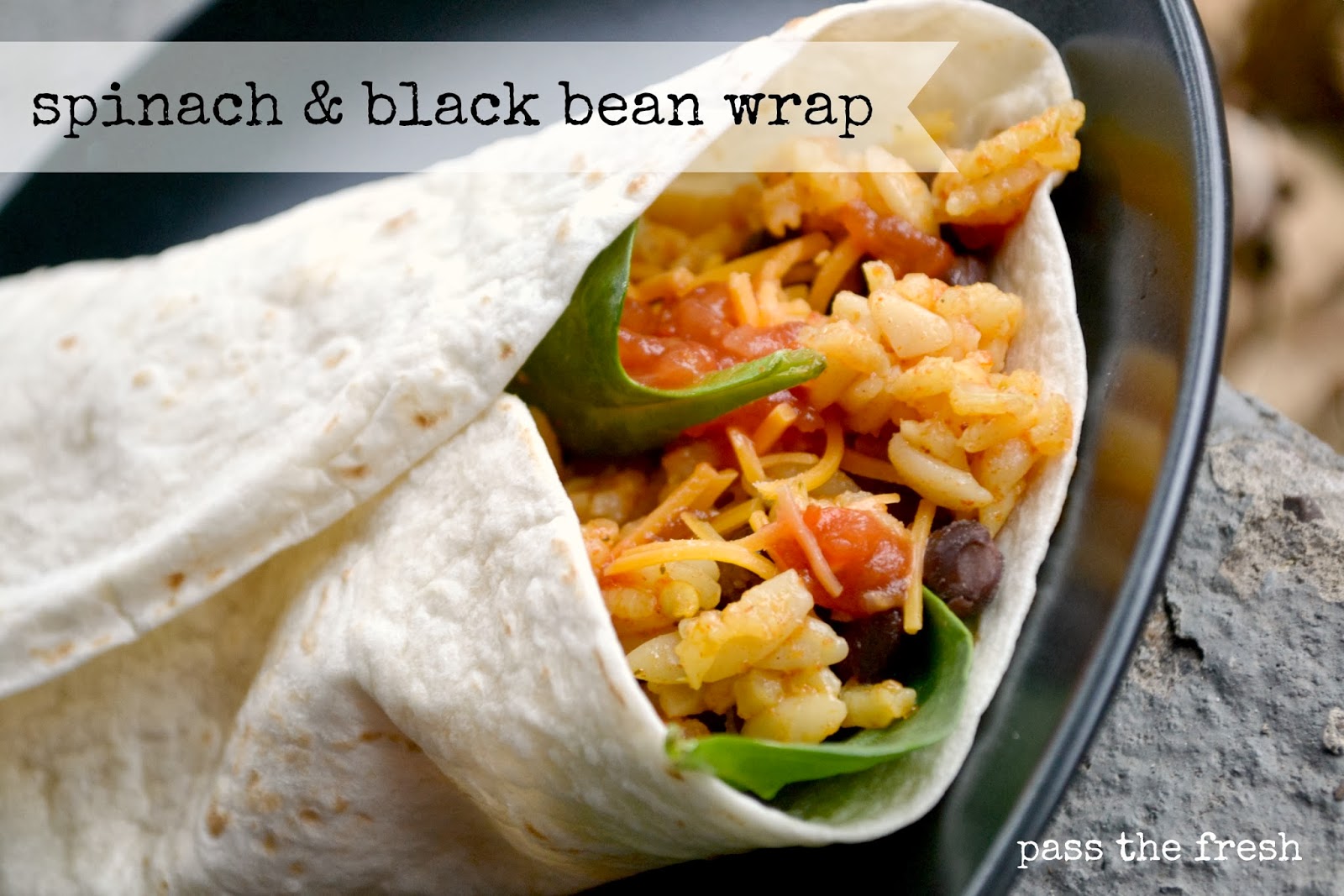
Spinach & Black Bean Wrap

I'm one of those people who is always looking for some easy lunch recipes. I work at a computer all day but don't have time to make any elaborate meals - so quick, easy, and easy to clean up are my requirements.

If you make the rice and spinach/bean mixture ahead of time, these wraps can be enjoyed in less than 5 minutes. I wasn't expecting a whole lot when it came to flavor, but holy cow these wraps are exploding with flavor! And even though without meat, they are very filling. Try them - you won't be disappointed!
Spinach & Black Bean Wrap
6 SERVINGS 
PREP: 5 minutes           COOK: 15 minutes            READY IN: 20 minutes


  SIMPLE         HEALTHY      YUM
pic name       pic name      pic name

INGREDIENTS


  • 6 cups baby spinach
  • 1 (15 oz) can black beans, drained
  • 1 1/2 cups cooked Rice-A-Roni Mexican Style Rice
  • 1/2 cup grated cheddar cheese
  • 1/2 cup salsa
  • 6 wraps or tortillas

DIRECTIONS


  1. Cook rice according to direction on box.
  2. Warm tortillas in microwave or place in oven, on a cookie sheet, at 300 degrees for 15 minutes.
  3. In a large skillet, warm spinach and black beans until spinach is wilted. About 3 minutes.
  4. Evenly distribute all ingredients in tortilla leaving 2" on one end for folding.

NUTRITION FACTS


    Serving size = 1 wrap   468 calories  8 g fat  87.4 g carbs   17.5 g protein   4.5g sugar   

Enjoy!
Recipe adapted from SkinnyMs.

Monday, February 10, 2014

Twice Cooked Pork

I'm here today sharing one of our favorite go-to dinners. It's delicious, and I must say it, nutritious. It's packed with protein, and the leeks in it add a great crunchy texture that leaves the dish fully satisfying. I must say that I have a great friend, Kuei, who taught me how to make this dish years ago, and it will always be a family favorite.


Twice Cooked Pork
6 SERVINGS 
PREP: 15 minutes           COOK: 15 minutes            READY IN: 30 minutes


  SIMPLE         HEALTHY      YUM
pic name       pic name      pic name

INGREDIENTS


  • 1 pound pork (I use the filets, but leftover pork roast might work too)
  • 2 Leek stalks
  • 1 tablespoon oil
  • 4 tablespoons soy sauce, divided
  • 1/2 teaspoon garlic powder
  • 1/2 teaspoon white pepper
  • 1 1/2 tablespoons black bean garlic sauce
  • 1 teaspoon chili garlic sauce (optional, we serve ours on the side so people can add as much spice as they wish to the dish)

DIRECTIONS


  1. In a medium pot, bring water to boil, and cook the pork for 8-10 minutes, or until done.
  2. While the pork is cooking, cut the leeks into 3/4" pieces and soak in water. After they have soaked for a few minutes, rinse thoroughly and set on a towel to dry.
  3. Once the pork is cooked, slice into bit sized pieces.
  4. Place a wok on medium heat. Once it's warmed up, add the oil. Add the pork and stir it for a minute.
  5. Put the leeks into the skillet and give it a good stirring.
  6. Add 2 tablespoons of soy sauce to the wok. Stir.
  7. In a small dish, combine the remaining 2 tablespoons of soy sauce, garlic powder, white pepper, sweet bean sauce and chili garlic sauce (optional). Mix it together with a fork.
  8. Add the soy sauce mixture to the wok and stir. 
  9. Cook for another minute or two, or until the leeks are starting to look like they are ready. You don't want to overcook them as they will be soggy.

NUTRITION FACTS


    1 serving    161 calories   5.3g fat   6.3g carbs    21.2g protein    1.9g sugar   

Enjoy!

Thursday, February 6, 2014

Wedge Salad with Cilantro Dressing


I don't know about you but I ate one too many treats during the Superbowl. I was probably eating my feelings...poor Broncos. But I'm ready to get back on track with healthy eating!

A quick meal doesn't always mean you need to pick up fast food and a healthy meal doesn't mean it takes 1 hour to prep. A simple wedge salad is always a good option to turn to. It's low in calories and you can load it up with whatever you want! We love having these staple ingredients in our house to turn to for an easy meal or snack!


Wedge Salad with Cilantro Dressing
8 SERVINGS 
PREP: 5 minutes           COOK: 20 (for bacon & eggs)           READY IN: 25 minutes

  SIMPLE         HEALTHY      YUM
pic name       pic name      pic name

INGREDIENTS


  • 1 head iceberg lettuce
  • 6 pieces bacon, cooked and chopped
  • 1/4 cup feta cheese
  • 4 hard boiled eggs, chopped
  • 1/4 chopped red onion
  • Ranch dressing or Cilantro dressing (see recipe below)
Cilantro Dressing
  • 6 oz fat free plain greek yogurt
  • 10 oz green salsa verde
  • handfull of cilantro
  • 1 teaspoon lime juice

DIRECTIONS


  1. Boil eggs for 15-20 minutes. When done cooking, let cool. Peel and chop. 
  2. Cook bacon and chop. 
  3. Finely chop onion.
  4. Cut head of lettuce into 8 sections.
  5. Drizzle with dressing.
  6. Layer bacon, hard boiled eggs, onion, and feta on lettuce. 

NUTRITION FACTS


  1 wedge w/o dressing   93 calories  6g fat   4g carbs   7g protein   2g sugar   


  1 wedge w/ dressing   110 calories  6g fat   6g carbs   9g protein   3g sugar   

Wednesday, February 5, 2014

Healthy Habits Challenge February: Eat Less Sugar


Welcome to our second month of our Healthy Habits Challenges for 2014! I hope you found some inspiration in Deb's January posts about losing weight with good nutrition and fitness - I know I definitely did!

For February, I'm here to share about my New Year's goal to Eat Less Sugar. First off, let me tell you about my relationship with sugar… In a word, I'm addicted. I mean, not to make it feel like an AA meeting, but I seriously have realized that I am 100% addicted to sugar. By that I mean that I often feel like I have no control over my sugar consumption - I crave it all the time (especially when I'm tired or stressed), I typically eat way more than I intend to, I feel guilty when I overdo it, and then - much as I tell myself I won't - I start the cycle over again. I hate to over-dramatize it, and certainly not to minimize the seriousness of truly life-destroying addictive behavior, but recently I've seriously had to admit to myself that my sugar-eating habits truly do mimic an addiction. And. I. don't. like. that.

I don't like feeling like my cravings control me, rather than me controlling my cravings.

Okay, now that I've given you my true confession, let me tell you a little about my goal (and my challenge to you) to eat less sugar. Historically, we've been told that sugar is "empty calories," and that it rots our teeth. (I feel like it was always the dentist giving you the most dire warnings about sugar, not so much your doctor or nutritionist, right?) I don't know about you, but I've always taken that to mean that even though it's not great for you, as long as you're eating an otherwise healthy diet full of all the nutrients you need (and brushing and flossing regularly) sugar is pretty benign. Maybe this has been my justification for my propensity for a sweet tooth, but I've always viewed it as that stuff that burns off easily as long as I'm living a healthy lifestyle. Haha … WRONG!

There is a ton of new research about the true nature of sugar in our diets, and I'm here to tell you that it's not happy news. Here are some of what they are discovering about sugar: (The science is pretty complex, so I'm simplifying things a lot here but …)
  • Sugar is addictive.
    • More and more scientists are discovering that sugar is genuinely addictive (as in eating it triggers similar brain centers as addictive substances, and going without it leads to similar physiological responses as going without addictive substances). That means that trying to eat it "in moderation" can be really, really hard for some. (For more on this, check out this great, short video about "Why sugar makes us feel so good!")
  • Eating sugar contributes more to weight gain than eating fat.
    • For a long time we've been on the "low-fat/ reduced fat" train when it comes to getting in shape and losing weight. But, as we're seeing more and more of the low-carb dieting take hold and gain evidence, there is increasing evidence that eating excessive sugar and carbohydrates is a greater contributor to weight gain than eating fat (especially if you are mainly eating the "good" fats). 
  • Sugar contributes to a host of other health problems (including diabetes, heart and cardiovascular diseases, poor sleep, headaches and body pain, and emotional issues)
    • It's hard to know for sure how much sugar plays a role in these issues, but there is clear and mounting evidence that it's a bigger role than we'd like to admit.
  • Sugar is everywhere, and as a society, we are eating way too much of it.
    • This fact is pretty much undisputed by anyone in the health and nutrition field. Sugar is cheap and easily accessible. It is everywhere, and is added to practically everything these days (and not just to "sweet" things). It's in drinks, salad dressings, bread, sauces (like ketchup, BBQ sauce, and tomato sauce), peanut butter, snack foods, health foods … you name it, it probably has some added sugar. And it is largely all that added sugar that is getting us into the most trouble.
Enough for the bad news, I've also discovered that there is some good news in all of this:
  • People who decide to eliminate or significantly reduce sugar in their diets seem to consistently report that they have more energy, sleep better, feel better, lose weight, enjoy the taste of food more, eat less food overall, and are generally happy to have gotten rid of excessive sugar in their diets. When I look at that list, and when I think about how much I know sugar affects me, I decided it was time to cut out the excuses and really try to eliminate the sugar monsters from my life.
Now that I've told you a little about sugar and the reasons I've decided to try to eat less sugar, I'm going to spend the remainder of February sharing some of my experiences, ideas, and support for anyone else who wants to join my challenge to eat less sugar. So, if you've been feeling like your own sugar monster has been screaming "More! More! More!" every time you pop a jelly bean or bite into a brownie, or if you just realize that sugar is sneaking into your diet more than it probably should, I'd love to have you join me in my Eat Less Sugar Challenge! In addition to my own experience trying to cut out sugar, I'll be sharing about:
  • how much sugar we should be eating,
  • where to sniff out hidden sugar (sometimes in shocking amounts), 
  • what to expect if you decide to cut out sugar - including the pros and cons of the moderation approach vs. some of the detox or sugar elimination methods out there,
  • how to curb sugar cravings,
  • the pros and cons of artificial and alternative sweeteners,
  • recipes for meals and snacks that are low-sugar or sugar-free … including some treats! (though I'll mostly focus on how to curb the feeling of wanting/needing sweet treats)
Most of what I share will be from my own experiences and some of the research that I've uncovered. Everybody's different, and obviously I'm not an expert in health or nutrition, but I am someone who is very interested in how to improve my lifestyle by eating in a way that makes me feel good … and if I have something that can help others do the same, I'm glad to share!

How much sugar is too much sugar?


Everyone's body is different, but as a general guideline, the American Heart Association recommends that women get no more than 25 grams (or about 100 calories), and that men get no more than 37.5 grams (or about 150 calories) of added sugars in our daily diet. Added sugars are those that are not naturally occurring in whole foods (like fruits and vegetables), but that are added during processing to enhance flavor or texture. These are considered free-floating sugars that kind of go rogue in your system and cause all sorts of havoc.

To give you an idea of what these numbers look like, if I eat a granola bar (which has about 12-13 grams of sugar) and 1/2 cup of pasta sauce (also about 12 grams of sugar) in a day I have right there met the AHA recommendation of 25 grams. Crazy, huh! As I've been watching nutrition labels for sugar content, I've been surprised sometimes by the amount of sugar, especially in foods that I want to think are good for me. For example, during a recent trip down the protein bar aisle of my local health food store, I was startled to realize that pretty much all of the mainstream protein bars out there (e.g. Clif, Balance, Quest, etc.) have sugar counts in the double digits - many of them with a total sugar of 20 grams or more! That would just about do it for you daily recommended sugar, and that's just in a supposedly healthy food. Drinks are an especially notorious place to watch out for sugars. Sodas, obviously, but also many bottled juices, teas, and energy drinks have upwards of 50-70 grams of sugar. Also, smoothies and specialty cafe drinks have very high sugar levels. (For more about the sugar content of popular foods, check out this article from WebMD.)

Now, I'm not saying that you should completely and permanently eliminate all of these foods from your diet (though some have and they report that they are happier for it). What I am saying is that I'm realizing that the more we pay attention to the sugar content of our food, in an effort to limit where we can, the better off it seems we'll be. And I'll be the first to admit that it's not easy, but that it is doable - I have definitely noticed as I've been working on this that my sugar cravings have decreased and that my appreciation for more subtle flavors in foods has increased! I can still feel my sugar monsters lurking, but I feel much more in control of them.

So, here's your first week's challenge to get started on the road to fighting the sugar monsters in your life:

Look for sugar in your diet


Sugar sometimes shows up in surprising places in our diets. Sometimes we don't realize how much sugar is in a food, but by reading labels you can start to be more aware of it. To give you an idea of what to look for, below are some of the names for sugar you'll find in ingredient lists (Hint: the more names and the closer to the top of the nutrition list they are, the more sugar is in that food.):

Here's your mission for this week: Notice how much and where you are getting sugar in your diet. Read labels on the foods you eat, looking for total sugar content (for me, anything around 4-5 grams I consider okay but worth monitoring, and anything over 9-10 should be limited), as well as if sugar shows up in the ingredients (especially within the first five ingredients). Try to keep track of your sugar intake, and if you are tracking your eating (like Deb recommended last month!), notice your total sugar intake at the end of each day.

I'd love to hear more about your relationship with sugar, and if you're up for this month's challenge to lower your sugar intake. I'd also love your feedback on what you would like to hear more about or work on. Leave comments below!

Tuesday, February 4, 2014

Cilantro Lime Chicken Soup

This was a recipe that just kind of happened in a round about way. I was craving a brothy, chicken soup (big surprise for me this time of year, I know), but I wanted something different than my Healthy Chicken Chili. I wanted something with a little more punch, or spice. So that is how this soup was created and it's now one of our favorites. The flavors are a perfect mix, with just a little kick to help you take in that chilly air.


Cilantro Lime Chicken Soup
6 SERVINGS 
PREP: 10 minutes           COOK: 25 minutes            READY IN: 35 minutes


  SIMPLE         HEALTHY      YUM
pic name       pic name      pic name

INGREDIENTS


  • 1 pound chicken breasts (2 large breasts), cooked
  • 32 ounces chicken broth
  • 22-ounce can diced tomatoes 
  • 10-ounce can diced tomatoes with green chiles
  • 1 cup frozen corn
  • 1 green pepper, diced
  • 2 large garlic cloves, minced
  • 1 teaspoon cumin
  • 1 teaspoon chili powder
  • 1 teaspoon salt
  • 1/4 teaspoon black pepper
  • 2 limes
  • Sour cream (optional, topping)
  • Cilantro (topping)

DIRECTIONS


  1. Shred the chicken, and put in a large pot with the chicken broth. Add the diced tomatoes and diced tomatoes with green chiles. Bring to a boil and simmer for 5 minutes.
  2. Add the corn, green pepper, garlic, cumin, chili powder, salt and black pepper. Cook for 10-20 more minutes. 
  3. Cut the limes in half and squeeze juice into the soup pot. 
  4. Serve and top with desired toppings.

NUTRITION FACTS


    1 cup serving    234 calories   6.9g fat   16.4g carbs    27.4g protein    6.8g sugar   

Enjoy!

Monday, February 3, 2014

Healthy Banana Chocolate Chip Cookies

I don't know if I've admitted this yet - but I'm addicted to sugar. My family knows it, my friends know it, my work knows it... okay, and I'm pretty sure all our readers know it too! I'm pretty much  known as the "sugar queen." And I realize this isn't the healthiest addiction - so I try my best to find sweet things that can pass for semi-healthy too.

Well, these banana chocolate chip cookies satisfy my sugar craving - but don't do me in on the sugar content. They are easy to make and super yummy - and only have 4.4 g of sugar per serving!! This is my kind of cookie people.


Healthy Banana Chocolate Chip Cookies
30 SERVINGS 
PREP: 15 minutes           COOK: 15 minutes            READY IN: 30 minutes


  SIMPLE         HEALTHY      YUM
pic name       pic name      pic name

INGREDIENTS


  • 2 1/3 cups quick oats (If using whole oats, put them in a food processor or blender for a few seconds to finely chop them up)
  • 3/4 teaspoon salt
  • 1 teaspoon cinnamon
  • 1 cup peanut butter
  • 1/4 cup honey or pure maple syrup
  • 2 ripe bananas, mashed
  • 1/3 cup chocolate chips

DIRECTIONS


  1. Preheat oven to 325ºF. 
  2. In a large bowl, combine all ingredients and mix either with a spatula or hand mixer. Make sure all ingredients are thoroughly combined. It will be sticky.
  3. On a greased cookie sheet, drop about 3 tablespoons worth of cookie dough for each cookie. The dough will not spread or rise, so flatten the cookies to your desired shape. 
  4. Bake for 12 - 15 minutes, or until slightly brown. You don't want to overcook the cookies because they will dry out. 

NUTRITION FACTS


    1 cookie    99 calories   5.3 g fat   10.7 g carbs    3.2 g protein    4.4 g sugar   

Enjoy!
Recipe adapted from Sallys Baking Addiction

Printfriendly

Related Posts Plugin for WordPress, Blogger...